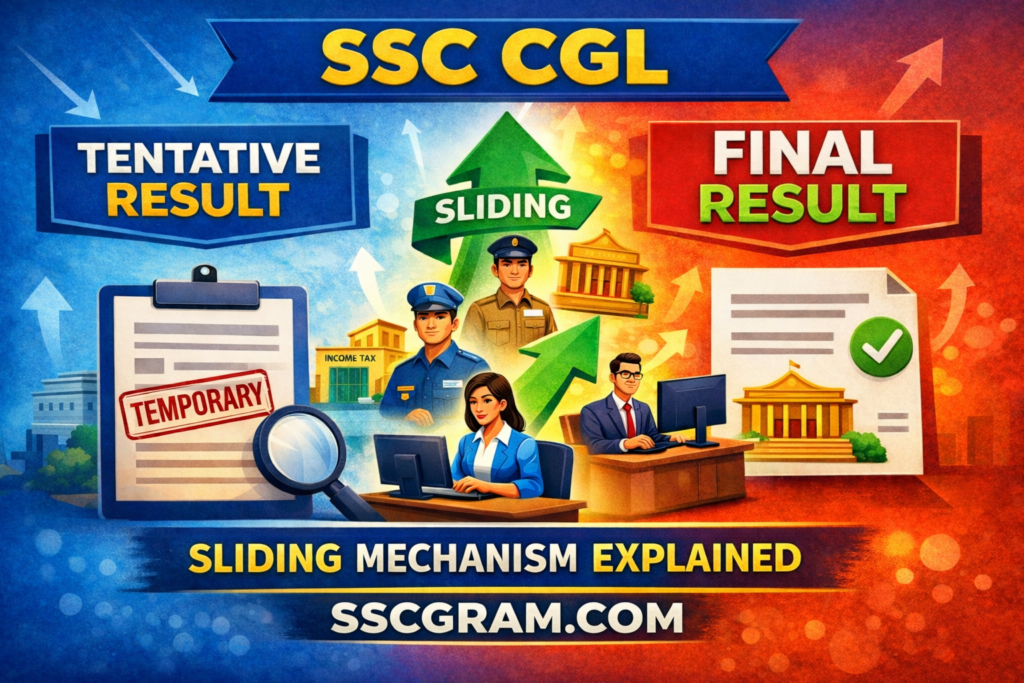

The SSC CGL 2025 result process is expected to introduce a more structured allotment system where candidates first receive a Tentative Result with FRTA (First Round Tentative Allocation) and later the Final Result after verification and sliding mechanism.
Many aspirants confuse these two stages. Understanding the difference between Tentative Result and Final Result is extremely important because it directly impacts post allotment, preference strategy, and final joining.
In this detailed guide, we will explain:
- What is SSC CGL Tentative Result
- What is SSC CGL Final Result
- How the Sliding Mechanism works
- What happens during Identity Verification
- FIX vs FLOAT options
- Real example of sliding allocation
- Strategy for Post Preference filling
SSC CGL 2025 Tentative Result vs Final Result – Key Difference
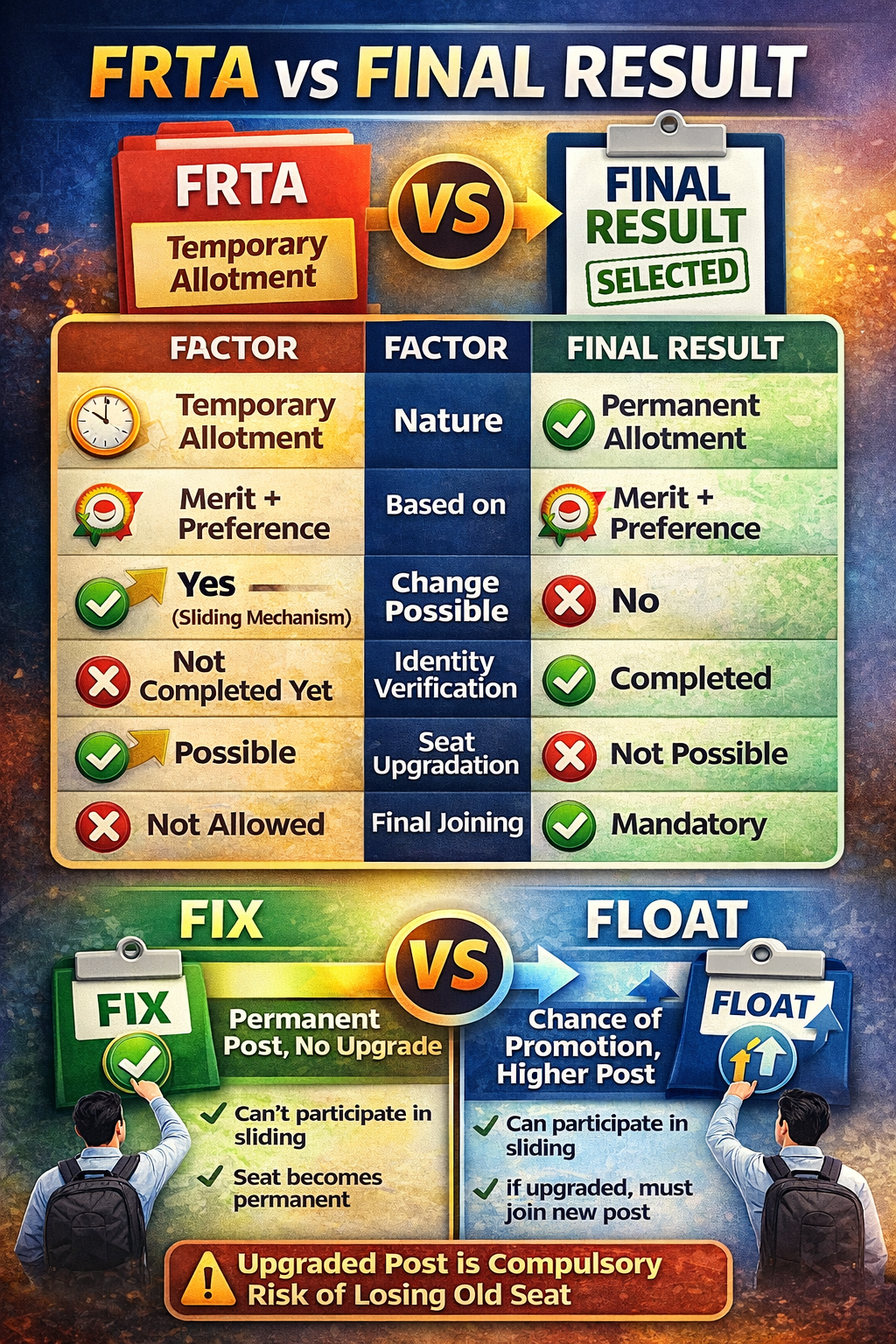
| Factor | Tentative Result | Final Result |
|---|---|---|
| Nature | Temporary allotment | Permanent allotment |
| Based on | Merit + Post Preference | Merit + Post Preference + Verification |
| Change Possible | Yes (due to sliding mechanism) | No |
| Identity Verification | Not completed yet | Completed |
| Seat Upgradation | Possible | Not possible |
| Final Joining | Not allowed | Mandatory |
Simple Meaning
Tentative Result:
A temporary post allocation given after merit preparation based on the candidate’s preferences.
Final Result:
The final confirmed post allocation after verification and sliding process.
Step-by-Step SSC CGL 2025 Result Process
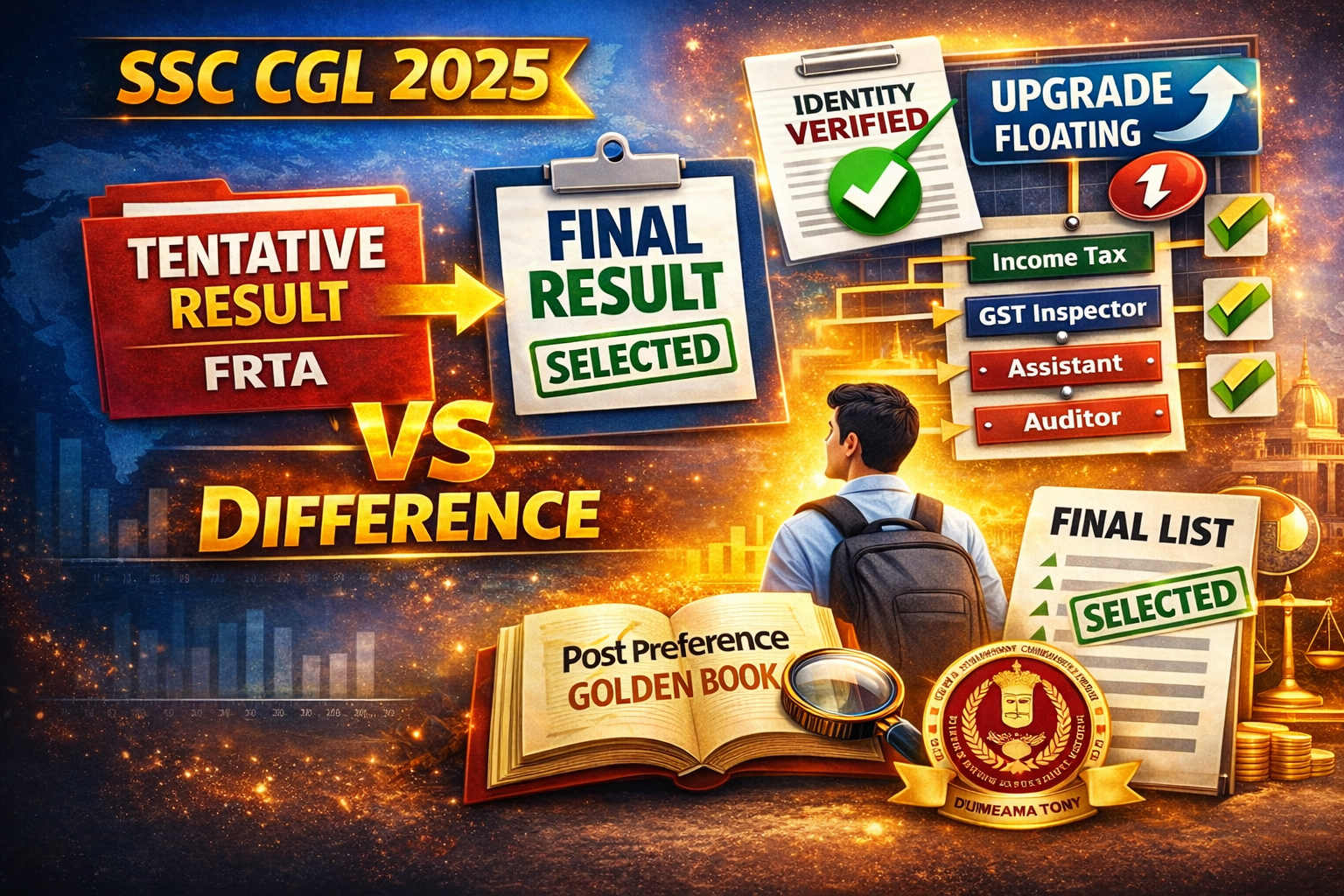
The expected process may follow the following sequence.
1️⃣ FRTA – First Round Tentative Allocation
After the merit list is prepared, SSC will generate the First Round Tentative Allocation (FRTA).
This allocation is based on:
- Candidate rank
- post preference order
- category
- available vacancies
At this stage:
- Every candidate receives a temporary post allotment
- This allotment is not final
- The system still allows upgradation through sliding
For example, if your rank allows a certain post but some candidates above you do not verify their identity, seats may become vacant.
Those seats are filled through sliding mechanism.
2️⃣ Identity Verification (IV)
After FRTA, candidates will have to complete Identity Verification.
Key rules
- Candidates must visit the SSC Regional Office
- Verification will happen through Aadhaar authentication
- The verification must be completed within 10 days
If a candidate does not appear for verification within 10 days, they will be removed from the process.
That means:
- Their allocated post becomes vacant
- The vacancy is used for sliding mechanism
This step ensures that only genuine candidates remain in the process.
3️⃣ Candidate Choice During Verification – FIX vs FLOAT
During the verification stage, candidates may be given two options.
🟢 FIX Option
If a candidate selects FIX, it means:
- They are satisfied with the allotted post
- They do not want any upgrade
Once FIX is selected:
- The candidate’s allocation becomes permanent
- The seat will not participate in sliding
This is the safe option.
🔵 FLOAT Option
If a candidate selects FLOAT, it means:
- They want upgrade to a higher preference post
- They are willing to move if a vacancy becomes available
However, there is an important rule.
If a candidate receives an upgrade, the new post becomes compulsory.
If the candidate refuses to join:
- Both old and new posts may be cancelled
Therefore, FLOAT has opportunity but also risk.
How SSC Sliding Mechanism Works
The Sliding Mechanism is the system used to fill seats that become vacant during verification.
Vacancies may arise due to:
- Candidates not appearing for Identity Verification
- Candidates opting out
- Candidates disqualified
Once seats become vacant, SSC reallocates them using merit order among FLOAT candidates.
The system works in a chain reaction.
Example – SSC Sliding Mechanism
Let’s understand with a simple example.
Available Posts
- Income Tax Inspector
- GST Inspector
- Assistant
- Auditor
Candidates (Rank Wise)
Rank 1 – Candidate A
Rank 2 – Candidate B
Rank 3 – Candidate C
Rank 4 – Candidate D
FRTA Allocation
After tentative allocation:
- A → Income Tax Inspector
- B → GST Inspector
- C → Assistant
- D → Auditor
Situation
Suppose Candidate B does not appear for Identity Verification.
That means:
- GST Inspector seat becomes vacant
Sliding Begins
If Candidate C selected FLOAT and GST Inspector is higher in their preference list, then:
C will be upgraded.
C: Assistant → GST Inspector
Now Assistant seat becomes vacant.
Second Sliding
If Candidate D also selected FLOAT and Assistant was higher in their preference list:
D will be upgraded.
D: Auditor → Assistant
Final Allocation After Sliding
Final result becomes:
- A → Income Tax Inspector
- C → GST Inspector
- D → Assistant
Auditor seat may go to the next candidate in merit.
Important Rules of Sliding Mechanism
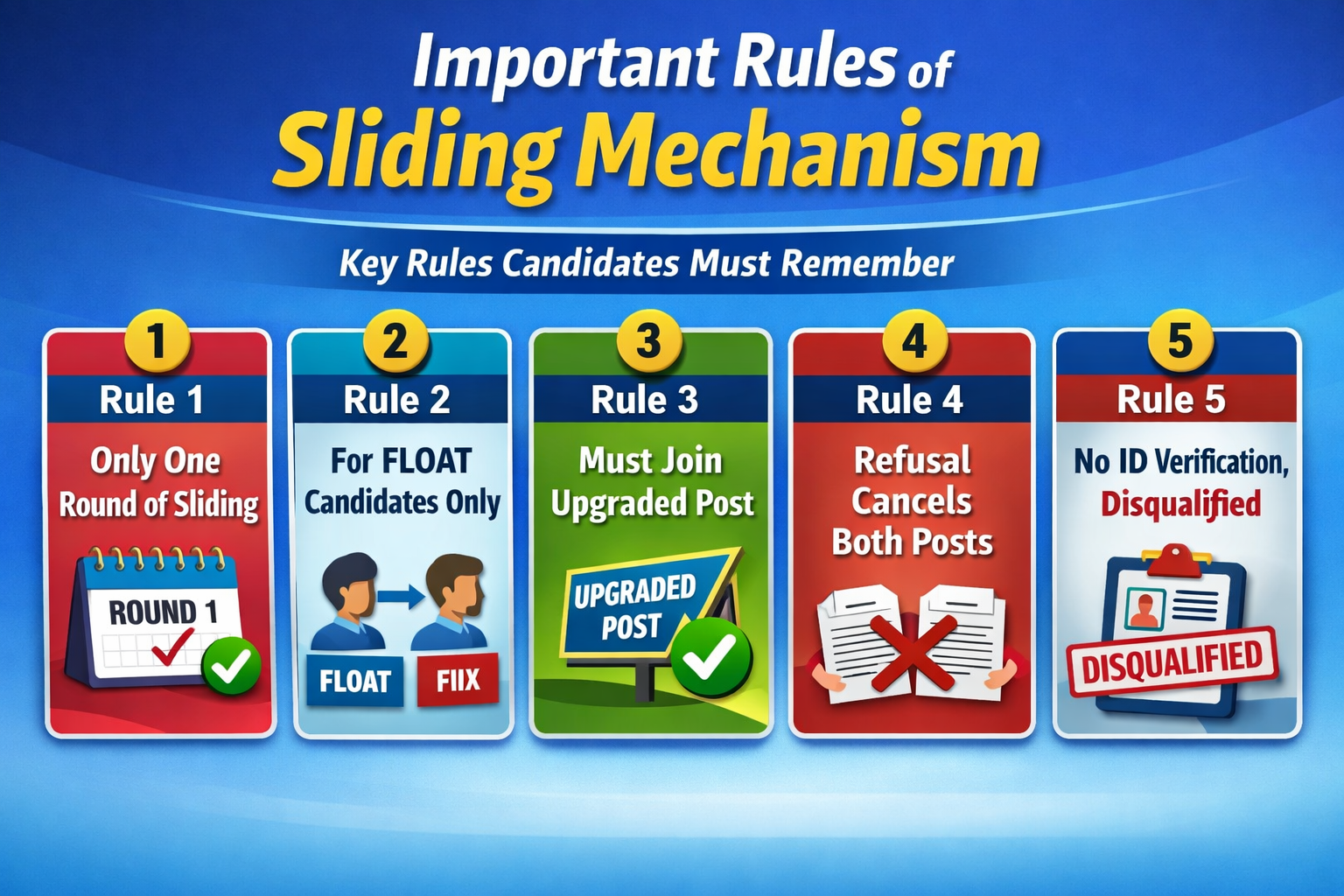
There are several key rules candidates must remember.
Rule 1
Only one round of sliding will occur.
SSC will not conduct multiple sliding rounds.
Rule 2
Sliding happens only among FLOAT candidates.
Candidates selecting FIX will not move.
Rule 3
If a candidate receives an upgrade:
They must accept and join the upgraded post.
Rule 4
If the candidate refuses the upgraded post:
Both posts may be cancelled.
Rule 5
Candidates who do not attend Identity Verification will be eliminated from the process.
SSC CGL Final Result
After completion of:
- Identity verification
- Sliding mechanism
SSC will publish the Final Result.
The final result contains:
- Final post allocation
- Department
- Category
- Rank
Once the final result is declared:
- No further change will occur
- Candidates must join the allotted department
Why Tentative Result is Important
The tentative result is important because it determines:
- Your initial post
- Your upgrade eligibility
- Your strategy for FIX vs FLOAT
Many candidates make mistakes because they do not understand the implications of FLOAT.
Sometimes candidates choose FLOAT hoping for upgrade but end up facing risk if preferences were filled incorrectly.
Why Post Preference Strategy is Critical
With the sliding mechanism, post preference strategy becomes extremely important.
If your preference order is not correct:
- You may get undesired upgrades
- You may miss your dream post
For example:
If your preference list is:
- Assistant
- GST Inspector
- Income Tax Inspector
Then even if Income Tax Inspector is better, the system will upgrade you to GST Inspector first.
Because SSC follows exact preference order.
Therefore, correct preference ranking is crucial.
Common Mistakes Candidates Make
Many aspirants commit the following mistakes.
Mistake 1
Filling preferences randomly.
Mistake 2
Not understanding department profiles.
Mistake 3
Ignoring promotion hierarchy.
Mistake 4
Following incomplete guidance from social media.
How to Fill SSC CGL Post Preferences Correctly
While filling preferences, candidates must consider:
- Promotion speed
- Posting location
- Work profile
- Department reputation
- Transfer policy
Popular posts like:
- Income Tax Inspector
- GST Inspector
- Assistant Section Officer
may not always be the best choice for every candidate depending on personal goals.
Therefore preference order should be carefully planned.
SSC CGL 2025 Strategy – FIX vs FLOAT
Choose FIX if:
- You got your dream post
- You do not want any risk
- Your post preference list may cause unwanted upgrades
Choose FLOAT if:
- You want higher preference post
- You are comfortable with upgrade rules
- Your preference list is correctly arranged
Important Advice for SSC Aspirants
If SSC implements the Tentative Result + Sliding Mechanism system, then the post preference stage will become one of the most important decisions in SSC CGL.
Many candidates with lower ranks may get better posts simply because they filled preferences correctly.
At the same time, some high-rank candidates lose good posts because they misjudge preference order.
Therefore candidates must prepare their preference strategy carefully before submission.
Post Preference Strategy Guide
To help candidates choose the best preference order, we created a detailed guide.
📘 SSC CGL Post Preference Golden Book
This guide contains:
- Complete post comparison
- Department work profile analysis
- Promotion hierarchy
- Zone wise risk matrix
- Strategy tools
- Real selection data
If you want a clear and safe strategy for SSC CGL post preference, you can purchase the guide from:
This guide will help you make data-driven decisions instead of guesswork.
Final Summary
The SSC CGL 2026 result system may involve two stages.
Stage 1 – Tentative Result
- Temporary post allocation
- Based on merit + preferences
- Sliding still possible
Stage 2 – Final Result
- After Identity Verification
- After sliding mechanism
- Permanent allocation
Candidates must carefully choose between FIX and FLOAT options during verification.
Understanding the sliding mechanism is essential because it determines how vacant seats are redistributed.
But the most important factor remains post preference strategy.
A correct preference order can significantly impact your final post.
🚀 For SSC preparation strategies, vacancy updates and post preference guidance join:
👉 https://t.me/sscgramofficial
And for the complete SSC CGL Post Preference Golden Book, visit:
👉 https://sscgram.com